The Samsa family’s financial hardship
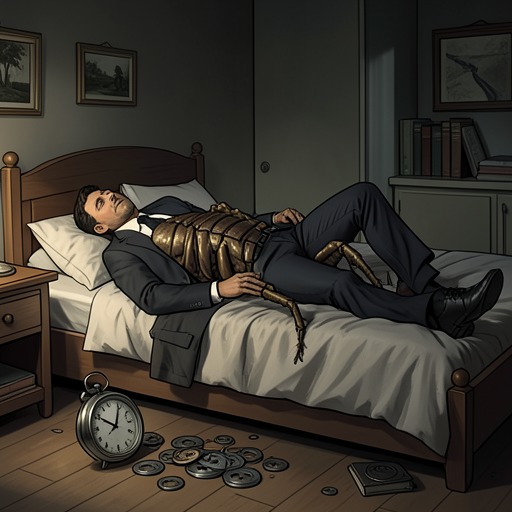
The MetamorphosisThe Samsa family’s financial hardship is the economic condition underlying the household’s fear, discipline, and changing treatment of Gregor Samsa. It begins with the collapse of Mr. Samsa’s business and the debt owed to Gregor’s employer, then persists through Gregor’s exhausting work as a travelling salesman. After Gregor’s transformation removes him from employment, the family’s hidden reserves, labor, possessions, and domestic arrangements are all recalculated. The crisis therefore functions not as background alone but as the force that converts a dependent household into a working one and makes Gregor’s continued presence increasingly difficult to accommodate.
Origins of the Debt and Gregor’s Burden
The family’s financial collapse had occurred five years before Gregor’s transformation, when Mr. Samsa’s business failed and the household was reduced to what the narrative describes as total despair. Gregor responded by working with unusual intensity, rising from junior salesman to travelling representative and placing his earnings on the table at home. His income enabled the family to continue living and was accepted with gratitude, while Gregor took satisfaction in providing for them; over time, however, the arrangement produced little remaining warmth in return, and Gregor’s closest bond became his relationship with Grete Samsa.
Gregor’s employment was governed by debt and by the threat of dismissal. He travelled constantly, worried about train connections, endured irregular food and continual contact with strangers, and contrasted his life with the more comfortable mornings of other travelling salesmen. He imagined resigning and confronting his boss, but postponed that decision until he could repay his parents’ debt, estimating that another five or six years would be necessary. His planned escape from the job was thus itself organized around the family’s financial obligation: freedom was imaginable only after Gregor had converted enough labor into repayment.
The family’s economic dependence also shaped the morning of Gregor’s transformation. His failure to rise for work immediately appeared as a possible threat to the household’s security. The Chief Clerk arrived at the Samsa family apartment on behalf of both Gregor’s parents and his employer, linking Gregor’s locked door to business failure, parental anxiety, and the possibility that his employer might again pursue the family over its debt. The Chief Clerk also reported that Gregor’s turnover had recently been unsatisfactory, so even before the transformation became visible, the household’s income was already vulnerable.
Hidden Reserves and the Limits of Security
Once Gregor was confined to Gregor Samsa’s room, Mr. Samsa explained the family’s actual finances to Mrs. Samsa and Grete. He had preserved some money from the failed business in a small cash box, and the family had not spent all of the money Gregor brought home each month. Those savings had accumulated with interest. Gregor, listening behind the door, felt relief and approval at this evidence of thrift because he had assumed that nothing remained from his father’s business and had believed that his own earnings were the household’s only protection.
The reserves, however, could not sustain the family indefinitely. They were sufficient for perhaps one or two years, but not enough to live on from interest; they had to be preserved for emergencies, while ordinary living expenses still required wages. The revelation changes the meaning of Gregor’s earlier sacrifice. His labor had supported the family, but it had not created lasting independence. It had helped preserve a limited financial cushion while leaving the household exposed to the sudden loss of its principal earner.
Gregor also recognized the personal cost of this financial structure. The accumulated money might have been used to reduce his father’s debt to his employer and bring his own resignation closer, but after his transformation that possibility no longer mattered in the same way. Whenever the family discussed the need for someone to earn money, Gregor released the door, threw himself onto the leather sofa beside it, and became overheated with shame and regret. The family’s financial problem was experienced by him as a moral failure, even though he had already carried the household’s expenses for years.
The Redistribution of Work
The loss of Gregor’s income forced the other members of the household into employment and intensified the work already required to maintain domestic life. Mr. Samsa, who had not worked for five years, was healthy but old, heavy, slow, clumsy, and lacking in confidence. Mrs. Samsa suffered from asthma and could spend every other day struggling for breath on the sofa by the open window. Grete, only seventeen, had previously enjoyed nice clothes, late mornings, modest pleasures, assistance in the family business, and the violin; the possibility that she would have to earn money marked a sharp reduction in the protected life she had known.
That possibility became reality. Mr. Samsa took a job connected with banking and retained his work uniform even at home, sleeping in the chair while dressed as though he were still awaiting orders from a superior. Mrs. Samsa washed clothes for strangers while also sewing fancy underwear for a fashion shop. Grete took a sales job and studied shorthand and French in the evenings in the hope of obtaining a better position. The family’s response to the crisis was therefore not a single replacement of Gregor by one wage earner but a redistribution of paid labor, domestic labor, and preparation for future employment.
The new arrangement left little time for Gregor. The household budget became smaller, the maid was dismissed, and the Charwoman was hired to perform the heaviest work, while Mrs. Samsa absorbed much of the remaining domestic labor on top of her sewing. The family also sold several items of jewellery, despite Mrs. Samsa and Grete’s fondness for wearing them at functions and celebrations. Economic hardship thus entered the household through schedules, clothing, possessions, and bodily exhaustion, not merely through an abstract shortage of money.
Confinement, Care, and Economic Exclusion
For the first fourteen days of Gregor’s confinement, Mr. Samsa and Mrs. Samsa could not bring themselves to enter his room. They waited outside while Grete tidied it and asked her to report what Gregor had eaten, how he had behaved, and whether there was any improvement. Grete’s unpaid care temporarily became another form of household labor, and the family’s concern was expressed through observation, feeding, cleaning, and the management of access to the room rather than through direct communication with Gregor.
The crisis also made the family’s housing feel impossible to alter. The flat was too large for their new circumstances, but they could not imagine moving because of the difficulty of transferring Gregor. At the same time, the narrative makes clear that practical transport was not the only obstacle: the family was overwhelmed by the sense that it had suffered a unique and unmanageable misfortune. Their inability to move therefore combined a material constraint with despair, while Gregor’s room became the fixed space around which the household’s reduced life was organized.
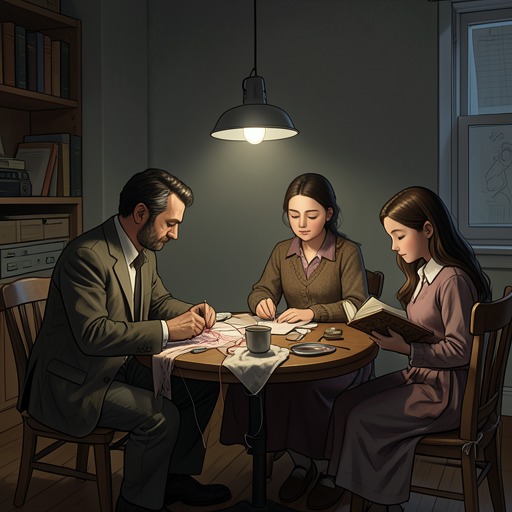
After Mr. Samsa began working again, the family’s evenings displayed the full cost of economic survival. Soon after dinner, he slept in his chair; Mrs. Samsa bent over her sewing beneath the lamp; and Grete studied for a better position. The lively conversations Gregor remembered from earlier times disappeared into quiet fatigue. His father’s uniform, kept on even at home and gradually becoming shabby despite the women’s care, became an emblem of renewed employment as both necessity and burden. The family was functioning economically, but only through a relentless extension of work into the home.
From Financial Liability to Recovered Prospects
The family’s economic distress sharpened the conflict over Gregor’s place in the household. During the lodgers’ stay, Grete declared that the family could not continue as it was and that they had to get rid of the creature in Gregor’s room. She argued that the household had already done everything humanly possible to care for it, but that its presence had driven out the tenants and threatened to force the family onto the streets. Her claim turns financial pressure into an argument for exclusion: Gregor is no longer described as the worker whose earnings sustained the household, but as a cost and a danger to its housing.
The family’s treatment of Gregor had never been entirely reducible to money, yet the economic crisis altered the balance between care and burden. Mr. Samsa still understood that Gregor’s injured body was connected to the family, and the apple lodged in Gregor’s flesh remained a visible reminder that he could not simply be treated as an enemy. Nevertheless, the household’s exhaustion, reduced budget, dismissed servant, sold jewellery, and dependence on several new jobs made patience increasingly conditional. Gregor’s presence required space, attention, and emotional effort at precisely the moment when the family had fewer resources for all three.
After Gregor’s death, the family’s economic outlook changed with startling speed. Mr. Samsa, Mrs. Samsa, and Grete wrote letters excusing themselves from work and then left the Samsa family apartment together for the first time in months. On the tram into the open country, they discovered that all three jobs were good and offered particularly promising prospects. They considered moving into a smaller, cheaper, and more practical flat in a better location, an option that had previously seemed unavailable amid their despair.
The outing also revealed a new future organized around Grete. Her parents noticed that she had become livelier and was developing into a young woman, and they silently agreed that it would soon be time to find a suitable husband for her. The family’s recovery is therefore both economic and social: once Gregor is gone, the household can imagine cheaper housing, promising employment, and Grete’s adult future. The financial hardship has not vanished, but the family has recovered the capacity to plan, and that renewed capacity exposes how completely Gregor’s life had been absorbed into the household’s economic survival.